


The Poems
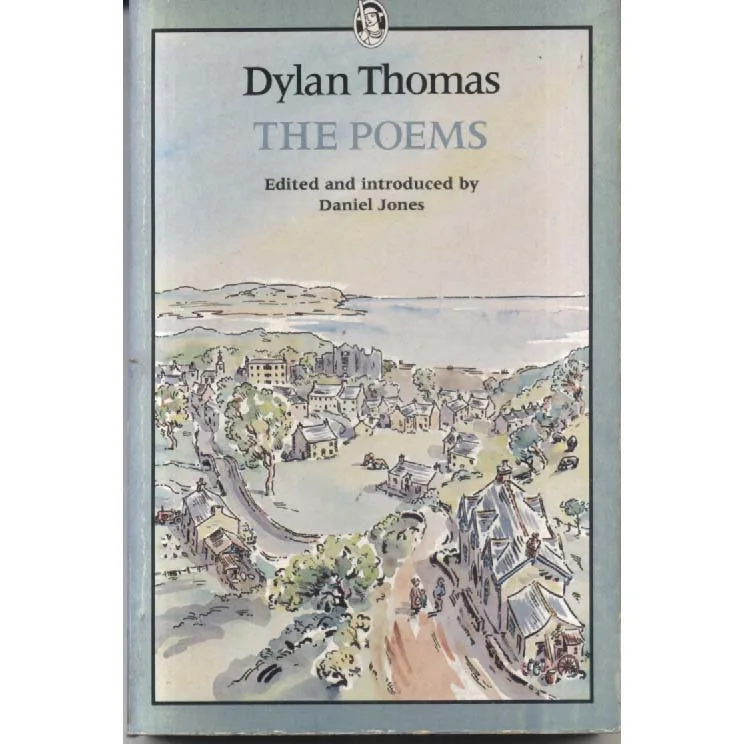
Publisher: JM Dent
Format: Paperback
ISBN: 9780460012997
There are poets, and then there is Dylan Thomas, who seems less like a mere writer than a force of weather passing through the English language at slightly theatrical speed. The Poems, published in 1990 by J. M. Dent, gathers the work of a poet who has long occupied that rare territory where lyric beauty, sonic richness, Welsh intensity, and full-throated verbal splendour all meet and agree to be magnificently excessive together.
Thomas is one of those writers whose reputation arrives in advance of him: lush, musical, haunted, brilliant, difficult in places, unforgettable in others, and forever accompanied by the faint sound of someone somewhere trying to quote Do not go gentle into that good night in a tone of grave conviction. Quite right too. His poetry is not shy. It does not sidle into the room apologising for its imagery. It arrives ablaze with sound, rhythm, flesh, death, time, childhood, sex, sea-light, biblical thunder, and the deeply inconvenient fact that language can still be beautiful enough to make ordinary prose look like it forgot to dress properly.
What makes Thomas so enduring is that he wrote poems which feel intensely alive on the tongue. Even before one has fully unpacked the meanings, one can hear them working. This is poetry as music, as incantation, as tide and breath and bell. The lines often seem built to be spoken aloud, rolled round the mouth, felt physically as much as intellectually. It is no surprise that Thomas became such a legendary reader of his own work. His poems do not merely ask to be read; they rather insist on being voiced, as if the page is only their first stage of existence.
There is, of course, a delicious irony in the title’s stark simplicity: The Poems. Not Selected Poems, not Collected Lyrical Masterpieces, not Songs for the Mortal and the Moon-Drowned. Just The Poems — as if no further adornment were needed. And perhaps none is. When the poet is Dylan Thomas, one can afford a little confidence. The title has the plain authority of a church door or a brass plaque. These are the poems. You know where you are.
And what poems they are: meditations on mortality, childhood, growth, decay, memory and the body, all rendered in a language so charged that even the natural world seems to be speaking in symbols. Thomas’s work has that glorious quality of being at once deeply rooted and faintly mythic. He can make a village, a farm, a hill, a body, a season feel at once entirely particular and cosmically significant. In lesser hands this would be absurd. In his it becomes inevitable.
There is also something wonderfully inconvenient about poetry of this quality. It refuses to stay tidy. It does not lend itself especially well to the brisk utilitarian mind. It asks for attention, for rereading, for surrender to sound and image, and occasionally for the reader to admit that not every great poem will immediately explain itself like a bus timetable. This is part of the pleasure. Thomas is not a poet of thin clarity and neat moral summaries. He is a poet of pulse and pressure, of language doing more than it strictly needs to, because that excess is where the life is.
This 1990 J. M. Dent edition has the added appeal of presenting Thomas in a handsome, sensible form: the sort of volume one can actually live with, return to, and shelve among other serious books while quietly knowing that most of them are less sonorous. A copy in Good condition feels exactly right. A poetry book ought to look as though it has been opened, revisited, perhaps underlined by someone briefly determined to understand the human condition through Welsh lyric intensity.
Sold by Crappy Old Books, whose self-deprecation remains one of the least accurate names in retail, this is a fine copy for readers of poetry, lovers of language, admirers of Dylan Thomas, and anyone who suspects that literature should occasionally sound as though it has swallowed thunder. The Poems is not background reading. It is not decorative. It is rich, resonant, difficult, dazzling and gloriously overqualified for a quiet evening — which is precisely why it belongs on the shelf.
Keep browsing: See more Poetry books Other books by Dylan Thomas
